


· By Boat Juice Team
The Ultimate Guide to Spray Wax for Boats
There’s nothing quite like the feeling of seeing your boat gleaming on the water, turning heads at the dock. But keeping that showroom shine can feel like a full-time job against sun, salt, and everything else nature throws at it. That's where a great spray wax for boats becomes your new secret weapon for keeping her looking sharp without losing a whole weekend to the effort.
Why Spray Wax Is a Game-Changer for Your Boat
Your boat's gelcoat is constantly getting hammered by harsh UV rays, corrosive saltwater, and plain old dirt. Left unprotected, that beautiful finish starts to oxidize, getting that dreaded chalky, faded look. A quality spray wax puts a tough, protective barrier between your gelcoat and the elements, preserving your boat's value and look without the back-breaking labor of old-school paste waxes.
Think of it as bringing your maintenance routine into the 21st century. Instead of blocking off an entire Saturday for a wax job, you can get a brilliant, slick finish in just a few minutes. That means less time scrubbing and buffing and more time actually enjoying your boat with family and friends.
The "Work Smarter, Not Harder" Advantage
The single biggest win for a marine spray wax is how incredibly easy it is to use. The simple "spray-on, wipe-off" application is perfect for any boater who wants pro-level results without the hassle. You can give your boat a fresh coat of protection right after you pull it out of the water, making it a quick part of your normal cleanup.
This small step in your routine pays off big time:
- Serious UV Protection: It acts like sunscreen for your boat, helping stop the sun from fading and breaking down your gelcoat—one of the biggest enemies of any boat finish.
- Effortless Cleaning: The wax creates a super slick, hydrophobic surface. Water just beads up and rolls right off, making it way harder for salt, scum lines, and annoying water spots to stick.
- Insane Gloss: It instantly amps up the shine and depth of your boat’s color, bringing back that "like new" look all season long.
Making spray wax a regular part of your care schedule is a total game-changer. For a well-rounded approach, especially if you have different types of boats, a solid inflatable boat maintenance guide can offer some great tips on protecting various materials.
At the end of the day, using a spray wax is all about working smarter. It’s a crucial tool in the arsenal of the savvy owner who wants to protect their investment. Now, let's get into the nitty-gritty of how it works and how you can get that perfect finish every single time.
Understanding How Marine Spray Wax Works
So, what’s the real difference between a spray wax for your boat and the one you grab for your car? It’s a great question. Think of your boat’s gelcoat like your own skin—it’s constantly battling a much harsher environment. We're talking intense sun, corrosive saltwater, and relentless moisture, which is a recipe for a dull, damaged finish if you're not careful.
Unlike your typical automotive wax, marine spray waxes are built for this fight. They’re formulated with beefed-up synthetic polymers and heavy-duty UV inhibitors specifically designed to bond with the porous surface of gelcoat or marine paint. This creates a slick, tough shield that can actually stand up to the abuse of the water.
The Science Behind the Shine
Let’s break it down with an analogy. A traditional paste wax is like a thick, heavy coat of sunscreen. It works, but you have to spend a ton of time and elbow grease rubbing it in perfectly to get full coverage. A modern marine spray wax? That’s like a high-end, spray-on sport sunscreen—it gives you fast, even, and powerful protection with way less effort.
But it’s not just about saving time. The polymers in these sprays create a microscopic layer that fills in the tiny imperfections in your gelcoat. This is what gives your boat that incredible gloss and slick-to-the-touch feeling. And that slickness isn't just for looks; it's doing some serious protective work.
Unlocking Hydrophobic Power
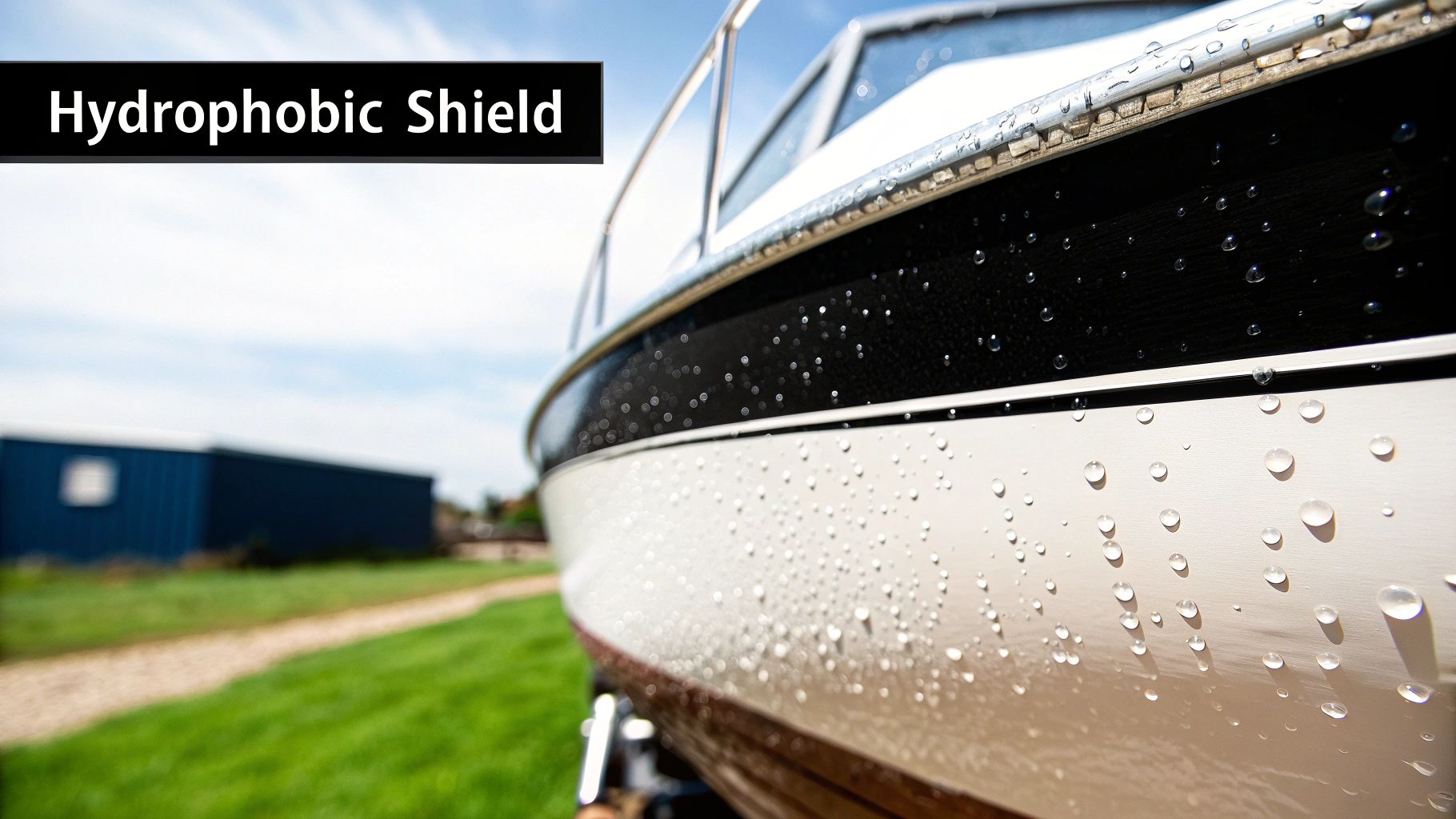
You'll hear the term hydrophobic properties thrown around a lot with boat waxes. It sounds complex, but it's a simple idea that makes a world of difference. "Hydrophobic" literally just means "water-fearing." When a surface is hydrophobic, water simply can't stick to it.
Essentially, a quality spray wax trains water to bead up and roll right off your boat's hull. This simple action prevents minerals and salt from drying on the surface, which is the primary cause of those frustratingly stubborn water spots.
This water-beading magic gives you two huge wins:
- Drastically Reduced Water Spotting: Since water—and all the gunk in it—is shed from the surface, you’ll spend a lot less time scrubbing away mineral deposits after a day out.
- Effortless Post-Trip Cleanups: Grime, salt, and lake scum have a much harder time getting a grip on that slick, waxed surface. Your end-of-day rinse-down becomes quicker and much more effective.
Preventing a Boater's Worst Enemy: Oxidation
Ultimately, the most critical job of a spray wax is to stop oxidation in its tracks. Oxidation is that chalky, faded, and dull look you see on older boats. It's the chemical breakdown of your boat's gelcoat caused by UV exposure, and it absolutely tanks a boat's appearance and value.
The special UV inhibitors in marine formulas act like a bodyguard for your gelcoat. They create a sacrificial layer that absorbs and reflects the sun's damaging rays before they can do any harm. The wax takes the beating so your expensive finish doesn't have to.
Products like Boat Juice Protection are designed to deliver this powerful UV defense in a simple spray-and-wipe application. By using it regularly, you’re not just making your boat shiny—you’re actively preserving its life. This kind of proactive maintenance is the secret to avoiding costly gelcoat restoration work down the road and keeping your investment looking brand new.
Choosing Between Spray Wax and Traditional Paste Wax
Trying to decide between a modern spray wax and a classic paste wax can feel like a tough choice. But really, it’s just about picking the right tool for the job.
Think of traditional paste wax as the marathon runner of boat protection. It's all about endurance, built to last a whole season, but it demands a serious time commitment and a whole lot of elbow grease to get it right.
On the other hand, a spray wax for boats is the sprinter. It’s built for speed, efficiency, and frequent use. It’s the perfect way to get a quick, high-gloss shine and top up your boat's UV protection between those big, heavy-duty waxing sessions. You’re not replacing the marathon with a sprint; you're just using the sprint to stay in top shape all season long.
The Right Tool for the Right Job
So, when do you grab the bottle instead of the can? The answer really boils down to your goals for the day and for the season ahead. One isn't inherently "better" than the other—they just play different roles in your boat care playbook.
Kicking off the season with a thorough cleaning and a meticulous paste wax application is a fantastic spring ritual. It lays down a super durable, foundational layer of protection that sets you up for success. But to keep that deep, just-waxed look going all summer, a quick wipe-down with a spray wax after each trip is the way to go.
The growing popularity of easy-to-use spray waxes is part of a bigger picture. The global wax market, which was valued at USD 10.05 billion, is expected to climb to USD 15.63 billion by 2035. Coatings and polishes, including marine sprays, are a huge part of this growth, all thanks to people like us demanding products that are both effective and efficient.
Spray Wax vs Paste Wax: A Quick Comparison
To make your choice crystal clear, let's put these two protectants head-to-head. This table breaks down the key differences so you can see at a glance which one fits your needs.
| Feature | Spray Wax (e.g., Boat Juice Protection) | Traditional Paste Wax |
|---|---|---|
| Application Time | 15-30 minutes | 2-4 hours (or more) |
| Effort Required | Low - Just spray and wipe | High - Requires a lot of buffing |
| Durability | Weeks to a month | Several months to a full season |
| Best Use Case | Regular maintenance, post-trip shine | Annual or semi-annual deep protection |
| Skill Level | Beginner-friendly | Intermediate - technique matters |
| Primary Goal | Gloss enhancement and UV top-up | Long-term foundational protection |
As you can see, spray wax totally shines when it comes to speed and ease of use, which is why it's a game-changer for today's busy boat owner. You can apply a product like Boat Juice Protection in the time it takes to unload your gear, making sure your boat is protected before it even hits the trailer.
When to Choose Each Method
Still on the fence? Here’s a simple way to think about it as you plan out your year.
Use a Traditional Paste Wax When:
- You're prepping your boat for the season. This is the perfect time to invest the effort for that deep, long-lasting base coat.
- Your gelcoat is looking a little tired or dull. A quality paste wax, maybe after a good polish, can bring back some of that richness and depth.
- You know you won't have time for frequent upkeep. If your schedule is packed, a durable paste wax provides excellent peace of mind.
Use a Spray Wax for Boats When:
- You need a quick touch-up. The ideal time is after every single trip. It zaps fresh water spots and beefs up that protective layer.
- You want to boost gloss and slickness. Nothing brings back that showroom shine faster than a quick spray-and-wipe before you head out.
- You want to make your next cleanup way easier. Using spray wax regularly prevents grime from sticking, so your end-of-day rinse is much more effective.
Now, if your boat's finish is dealing with more serious oxidation, a wax alone isn't going to cut it. You might need to restore the gelcoat first. You can check out our guide on boat compounding and polishing to learn how to prep the surface the right way. That foundational step is key to making sure your wax—whether it's a spray or a paste—can bond properly and give you the best possible results.
How to Apply Spray Wax for a Flawless Finish
So, you're ready to get that slick, just-detailed shine all on your own? The good news is, getting a professional-looking finish with spray wax is surprisingly easy. The real secret isn't some complicated technique—it's all in the prep and a few simple tricks of the trade. I'll walk you through the whole process, from washing down the hull to that final satisfying buff, so you nail it on the first try.
The straightforward application is exactly why spray wax has become so popular, especially for the everyday boater. Think about it: in the U.S., a whopping 70% of recreational boats are the trailerable kind—wake boats, ski boats, and pontoons. For those of us who just want to get out on the water, ease of use is everything. It’s no surprise that demand for simple, effective products has pushed marine detailing spending up 18% to $2.5 billion annually. In fact, sprays are the go-to for 62% of pros because they can quickly lay down a solid barrier against UV rays and salt. You can get the full rundown on the market growth in this comprehensive market analysis.
Step 1: Start With a Clean Slate
You’d never wax a dirty car, and your boat is no different. Trying to apply wax over a layer of salt, grime, or water spots just traps all that junk against your gelcoat. Not only can this cause fine scratches, but it also stops the wax from bonding properly. A perfectly clean surface is non-negotiable.
Before you even think about picking up that spray bottle, give your boat a good, thorough wash. If you need a refresher, our guide on how to clean fiberglass boats has some great, no-nonsense tips. After washing, make sure the surface is completely dry.
Here’s another pro tip: always work in the shade or on a cool day. Applying spray wax to a hot surface is a one-way ticket to a streaky disaster. The heat makes the wax evaporate almost instantly, long before you have a chance to spread it out. It just dries in splotches instead of creating that smooth, uniform layer you’re after.
Step 2: Gather Your Simple Tools
The beauty of spray wax is how little you need to get the job done. You can forget about heavy buffers or a pile of different applicators.
All it takes are two things:
- Your Spray Wax: Grab a quality marine-specific formula made for gelcoat, like Boat Juice Protection.
- Two Clean Microfiber Towels: This is the single best trick for a streak-free shine. Trust me. One towel is for applying the wax, and the second, dry one is for buffing it to perfection.
Why two towels? It's simple. The first towel gets damp as you spread the wax. If you try to buff with that same towel, you're just smearing the product around, which leaves behind a hazy, streaky film. A fresh, completely dry towel is the key to lifting that excess residue and revealing that brilliant shine underneath.
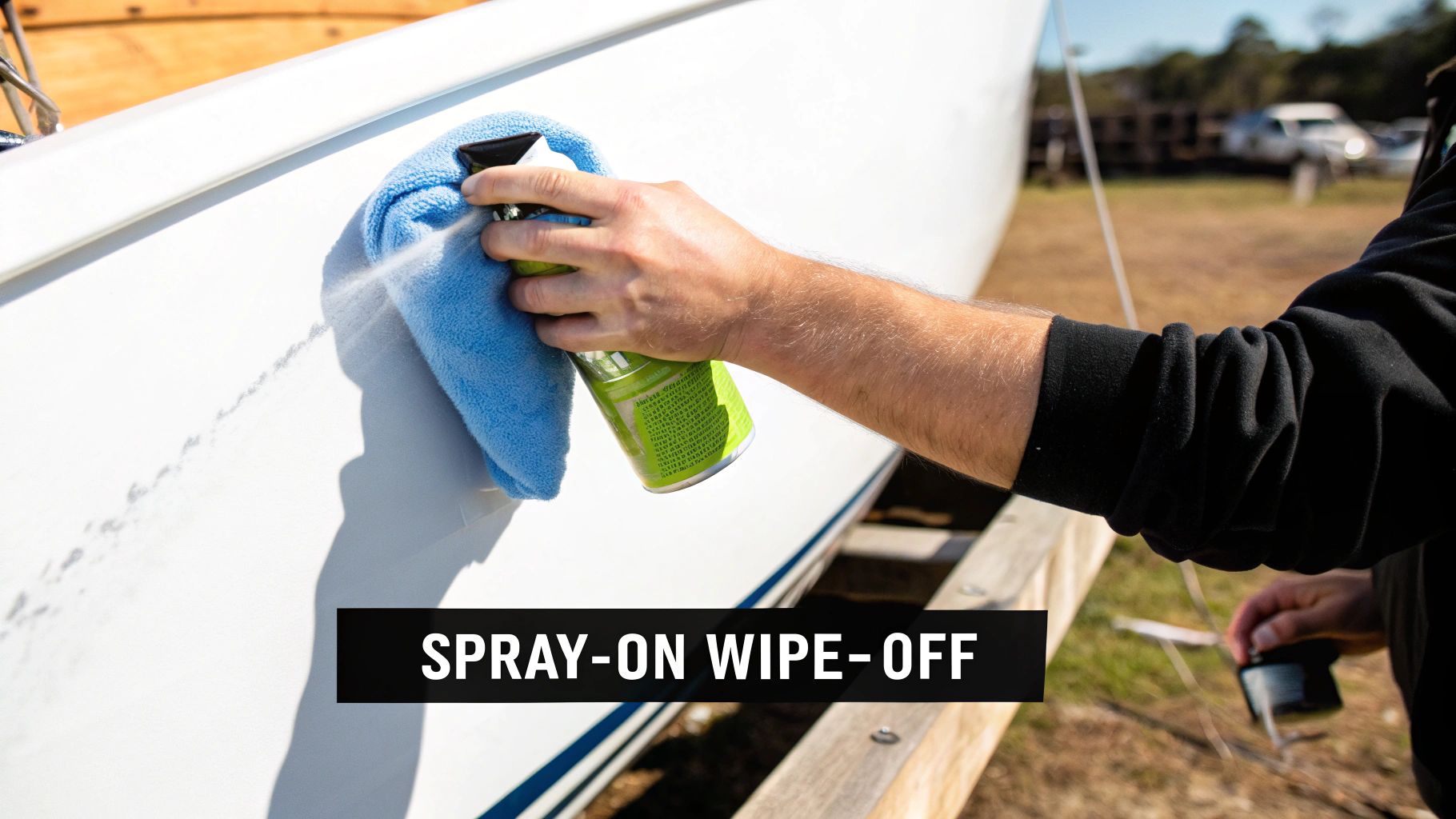
Step 3: The Spray-On, Wipe-Off Method
Alright, now for the fun part. This process is fast, easy, and incredibly satisfying. Just follow this simple rhythm, and you’ll get a perfect finish every time.
-
Work in Small Sections: Don't try to tackle the whole boat at once. Focus on a small, manageable 3x3 foot area at a time. This keeps you in control and ensures the wax doesn't dry before you can buff it off.
-
Spray and Spread: Give the section a light mist of spray wax. You really don't need to soak it—a little goes a long way. Take your first microfiber (your "wet" towel) and gently wipe the wax across the surface in straight, overlapping passes to get even coverage.
-
Flip and Buff: Immediately switch to your second, clean microfiber towel (the "dry" one). Using light pressure, buff the area to a high-gloss shine. You're just removing any leftover haze, leaving behind that slick, protective layer that makes water bead right off.
That’s it! Once one section is done, move right next to it and repeat the process. By working your way around the boat methodically, you’ll be done in no time, leaving you with a durable, water-beading shine that looks like it took hours to achieve.
Common Mistakes to Avoid When Using Spray Wax
Using a spray wax for boats is supposed to be easy, right? It's one of the fastest ways to get a killer shine, but a few common slip-ups can turn a quick job into a frustrating mess. Even the best products have a right way and a wrong way to be used.
Let’s walk through the most frequent mistakes I see people make so you can sidestep them and get a flawless, streak-free finish every single time.
The good news? These errors are incredibly easy to fix. Once you know why they cause problems, you'll naturally avoid them and start getting those pro-level results you’re after.
Mistake 1: Working on a Hot Surface or in Direct Sun
This is, without a doubt, the number one cause of streaks and haze. If your boat's gelcoat is hot to the touch, the wax is going to flash-dry the instant it hits the surface. Instead of spreading into a thin, even layer, it bakes on in splotches, making it a nightmare to buff off cleanly.
The Simple Fix: Always try to work in the shade, early in the morning, or on a cool, overcast day. Not sure? Just touch the hull. If it feels warm, wait for it to cool down. This one change will make the biggest difference in your results, I guarantee it.
Mistake 2: Using Way Too Much Product
It’s a natural instinct to think more wax equals more shine, but with spray waxes, the opposite is true. Drenching the surface just creates a ton of extra work for yourself, as you’ll have to fight to buff off all the excess. That leftover residue is exactly what creates that greasy, hazy look, and it becomes a magnet for dust and dirt.
The Simple Fix: Remember, a little goes a long way. A light mist over a 3x3 foot section is plenty. If your microfiber towel starts feeling heavy and saturated, you're definitely using too much.
The goal is to leave a thin, protective film behind, not a thick, oily layer. A quality, user-friendly formula like Boat Juice Protection is designed to flash quickly and buff off clean, making it more forgiving if you accidentally spray a little extra.
Mistake 3: Trying to Wax the Entire Boat at Once
This mistake is a close cousin to working on a hot surface. If you spray down the entire side of your hull before you even start wiping, the wax at one end will be completely dry and cured before you can possibly get to it. You’ll be left fighting a streaky, stubborn film that’s a real pain to remove.
The Simple Fix: Work in small, manageable sections. That 3x3 foot rule of thumb is your best friend here. Spray, spread, and buff one area completely before moving on to the next. This ensures you’re always working with fresh, workable product, which is the key to a smooth, uniform shine.
These simple adjustments are the difference between a frustrating afternoon and a beautiful finish. And it's no surprise that the market is shifting toward products that make this process easier. A recent industry report notes a 4.5% CAGR in the wax market through 2028, with easy-to-use hydrophobic and UV-resistant sprays being major drivers.
While 68% of boat owners still apply a traditional wax seasonally, these user-friendly spray variants can slash that application time by up to 70%—all while helping prevent costly oxidation. You can get more details about these market trends and their impact in the full report.
Got Questions About Boat Spray Wax? We've Got Answers.
It's totally normal to have a few questions, even with a product that seems simple. In fact, it's a good thing—it shows you care about getting the job done right. Let's walk through some of the most common questions we hear from boat owners just like you, so you can start waxing with confidence.
Think of us as your virtual dock neighbor, here to clear things up and help you get an incredible shine every single time.
Can I use spray wax on other parts of my boat?
You bet! A good marine spray wax is surprisingly versatile. You can use it on pretty much any smooth, non-porous surface to give it a little extra shine and protection.
- Painted Surfaces: It'll boost the gloss and add a nice protective topcoat.
- Stainless Steel: Great for preventing those annoying water spots and rust on railings and hardware.
- Windows and Glass: It makes water bead up and roll right off, which really helps with visibility when you're dealing with spray.
Just be sure to keep it off your non-skid deck surfaces. It works a little too well, and you don't want to turn your deck into a slip-n-slide. For the inside stuff like vinyl and seats, stick with a product made for interiors, as it cleans and protects those materials properly without leaving a slick, greasy mess.
Will spray wax get rid of the oxidation or water spots I already have?
This is a really important distinction: spray wax is for protection, not correction. Its whole job is to protect a clean, healthy finish and keep new oxidation and water spots from forming. It's the last step in your cleaning process, not the first.
If your gelcoat is already looking chalky or has stubborn, etched-in water spots, a spray wax just isn't going to cut it. You’ll need to roll up your sleeves and fix the underlying problem first. That usually means using a polish, a light compound, or a dedicated water spot remover. Once you've brought that surface back to life, then the spray wax becomes your best friend for keeping it that way.
How does spray wax handle saltwater?
This is where marine-specific formulas really shine. They're built from the ground up to stand up to the brutal saltwater environment. The polymers in the wax create a tough, slick barrier that keeps corrosive salt from drying on your gelcoat and causing damage.
Think of it like a raincoat for your boat. That protective layer makes your end-of-day rinse-down way more effective because the salt and gunk just slide right off instead of sticking around.
There's no doubt that saltwater is hard on any finish. But applying a quick coat of spray wax after each trip is one of the easiest and most effective ways to fight back. It’s a simple, renewable layer of defense that keeps salt damage and corrosion at bay all season long.
Now that you know how to get a perfect shine in minutes, your next step is to make it part of your routine. After your next trip out on the water, grab a bottle of spray wax and two microfiber towels. Spend just 15 minutes wiping down the hull—you'll be amazed at how much easier your cleanup becomes and how great your boat looks.