


· By Boat Juice Team
Protect Your Boat with a Salt Away Engine Flush: Your Ultimate Guide
If you're a saltwater boater, a regular salt away engine flush isn't just a good idea—it's essential. This simple task involves running a special solution through your engine's cooling system to dissolve salt deposits that a freshwater rinse alone can't handle. Doing this prevents hidden corrosion and keeps your engine from overheating.
Think of it this way: spending just 15 minutes on a flush after each trip is one of the smartest investments you can make. It protects your engine's long-term health and gives you priceless peace of mind on the water.
Why Your Engine Needs More Than Just Freshwater
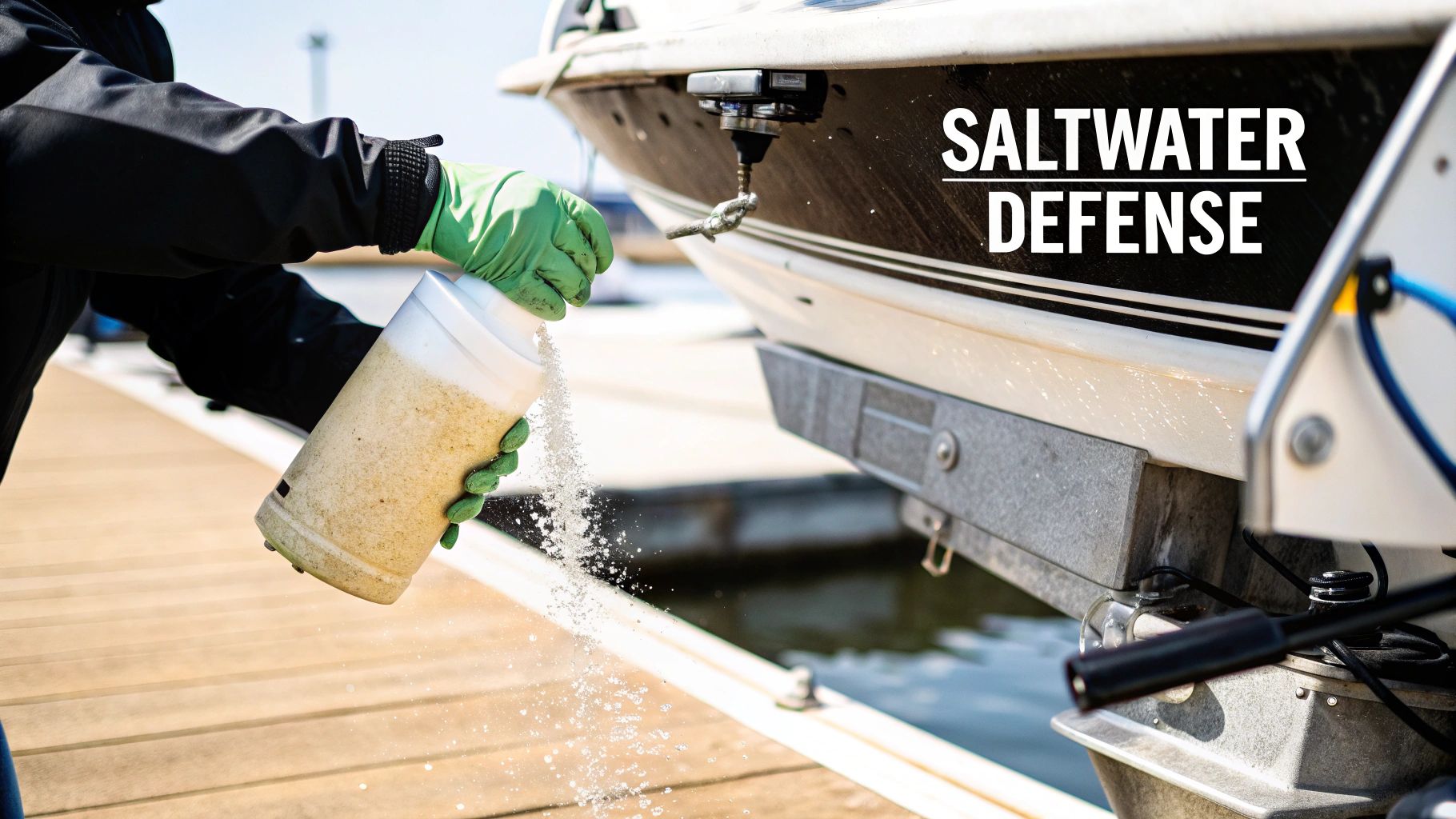
You already know the drill: after a day in the salt, you rinse everything down with fresh water. But when it comes to the complex internal passages of your engine, water alone just doesn't cut it against the real enemy: salt crystals.
It’s like trying to wash a greasy pan with only cold water. It might look clean, but a sticky film remains. That’s exactly what happens inside your engine's cooling system after a day on the ocean.
Saltwater leaves behind tiny salt deposits that cling to metal surfaces. Over time, these deposits build up, restricting the flow of coolant and forcing your engine to run hotter. This leads to poor performance, accelerated wear, and eventually, a massive repair bill you didn't see coming.
The Science of Salt Removal
This is where a dedicated salt-removing solution really proves its worth. Unlike plain water, a product like Salt-Away has active ingredients that chemically break down and dissolve salt. It doesn’t just rinse the salt away; it neutralizes its corrosive power and leaves behind a protective, anti-corrosive film.
This invisible shield guards your engine’s internal components, protecting them until your next adventure on the water. It's a proactive defense against the silent damage that saltwater inflicts.
Salt is relentless, and internal corrosion is often invisible until it's too late. An effective flush doesn't just clean; it actively protects the heart of your boat from the inside out.
The High Cost of Skipping the Flush
Let's be blunt: ignoring this simple maintenance step can cost you serious money. In any major saltwater boating area, internal engine corrosion is a leading cause of premature failure and eye-watering repair bills.
Industry surveys estimate that a staggering 30–40% of premature outboard failures aren't due to mechanical breakage but are directly linked to internal salt corrosion. It’s no surprise that salt-fighting products like Salt-Away were developed to combat this widespread—and preventable—issue. You can find some great independent reviews on these solutions over at Practical Sailor.
Freshwater Flush vs. Salt Away Flush: Key Differences
Still not sure if a dedicated flush is necessary? Let's break down exactly what you're getting compared to a simple hose-down. This chart shows you why one method is far superior for engine health.
| Feature | Freshwater Flush | Salt Away Engine Flush |
|---|---|---|
| Salt Removal | Rinses away loose surface salt crystals | Chemically dissolves and neutralizes embedded salt |
| Corrosion Prevention | Minimal; water can even accelerate oxidation | Leaves a protective anti-corrosive film on surfaces |
| Long-Term Effect | Allows salt buildup over time in deep areas | Prevents buildup and actively removes existing deposits |
| Engine Temperature | Can't clear blockages causing overheating | Helps maintain clear passages for optimal cooling |
| Best For | Better than nothing; a temporary rinse | Essential post-trip maintenance for saltwater boaters |
Ultimately, while a freshwater rinse is a good first step, only a dedicated salt-removing flush gives your engine the deep clean and lasting protection it truly needs. By making a proper flush part of your post-trip ritual, you're not just cleaning your engine—you're extending its life and protecting your investment.
Getting the Right Gear for a Flawless Flush
Before you can give your engine the flush it deserves, you need to gather the right gear. Having the correct tools on hand turns a frustrating chore into a quick, easy job. Think of this as your pre-flush checklist—it makes the whole process smooth and guarantees you’re doing it right.
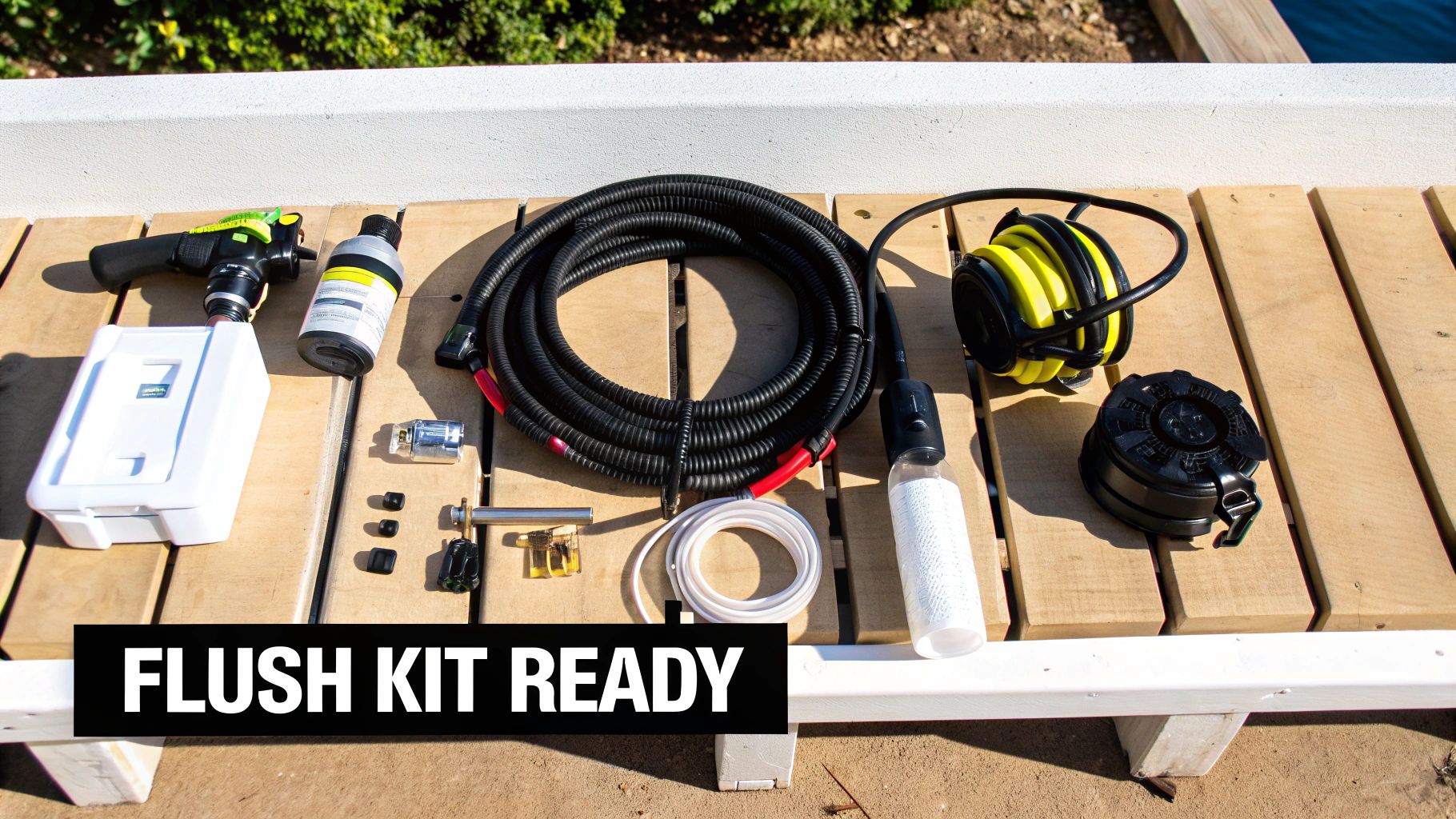
This isn’t about buying expensive gadgets. It’s about having a few key items that make the job simple and, more importantly, effective. Get this right, and you'll avoid annoying leaks and that nagging feeling of, "is this even working?"
Your Essential Flushing Toolkit
Your basic kit is pretty simple, but don't cut corners here. A cheap, leaky hose or muffs that won't seal can turn a ten-minute task into a half-hour of frustration.
Here’s the bare minimum you'll need:
- A Quality Garden Hose: Get one that doesn't kink easily. Make sure it's long enough to reach your boat comfortably from the spigot without being stretched tight.
- Engine Flush Muffs (or 'Earmuffs'): If you have an outboard or a sterndrive, these are non-negotiable. They clamp over the water intake vents on the lower unit, creating a seal so you can pump fresh water and your flushing solution directly into the cooling system.
- A Flush Port Adapter: Many newer outboards have a built-in flush port. If yours does, you just need a simple threaded adapter to connect your hose. Always check your owner’s manual to see what your engine manufacturer recommends.
The Secret Weapon: The Salt-Away Mixing Unit
You've got the hose and the muffs, but the real star of the show is the Salt-Away Mixing Unit. This brilliant little device screws right onto your hose and is designed to automatically mix the Salt-Away concentrate with fresh water at the perfect ratio.
This feature completely removes the guesswork from the process.
You just fill the cup with Salt-Away, connect the unit between your hose and your muffs, and turn on the water. It delivers a perfectly diluted, consistent stream of the solution through your engine. No more measuring or trying to mix it in a bucket—it’s foolproof.
A proper flush isn't just about rinsing the engine's insides. It's about getting a correctly diluted, corrosion-busting solution into every nook and cranny of the cooling system. The mixing unit makes that happen every single time.
Using a dedicated mixer is like using a foam cannon to wash your hull. A specialized tool like the Boat Juice HydroSuds Sprayer lays down a thick, even layer of soap for a much better clean. The Salt-Away mixer does the same for your engine's internals, ensuring the product can do its job effectively.
How to Perform a Salt Away Engine Flush Like a Pro
Alright, you have your Salt-Away and flush muffs ready. Now it’s time for the main event. The process is simple, but getting the sequence right is critical to protecting your engine properly.
We'll walk through the most common setup: an outboard or sterndrive using flush muffs. If your motor has a built-in flush port, the job is even easier. Either way, the goal is the same: get the salt out and leave a protective film behind.
Step 1: Get Your Gear Hooked Up Right
First, get the "earmuffs" on the lower unit. You're looking for a snug seal over the raw water intake vents. If they're loose, water will spray everywhere instead of getting sucked into the engine where you need it.
Next, grab your Salt-Away Mixing Unit. Fill the cup with the Salt-Away concentrate. Screw the mixer onto the end of your garden hose, then attach the hose from your flush muffs to the other side of the mixer.
A classic mistake is starting the engine before the water is flowing. Running the raw water pump (the impeller) dry for even a few seconds can damage it. Always turn the water on before you turn the key.
Step 2: The Flushing Sequence: A Simple Walkthrough
With everything connected, you're ready to start. The process has two main phases: a quick freshwater rinse, followed by the Salt-Away application to dissolve stubborn salt deposits.
- Start with a Freshwater Rinse: Set the switch on your mixing unit to "RINSE" (water only). Turn the spigot on all the way. You should see water coming out from around the muffs. Now, start your engine.
- Check for the "Tell-Tale": Every outboard has a "tell-tale" stream—a small stream of water that shoots out. A steady stream confirms that water is circulating properly. Let it run on fresh water for 2 to 3 minutes.
- Bring in the Salt-Away: While the engine is running, flip the mixer switch to "SALT-AWAY." You’ll see foamy water coming out of the tell-tale and exhaust. That’s the solution getting to work inside your engine.
- Let It Circulate: Run the engine with the Salt-Away solution for about 45 to 60 seconds. This is plenty of time for it to coat all the internal cooling passages.
- The Critical Shutdown: To leave that protective film inside, you must shut things down in the right order. First, turn the engine OFF. Then, turn the water supply OFF at the spigot. This traps the Salt-Away inside, letting it prevent corrosion while your boat sits.
By following that shutdown sequence, you leave a protective coating inside the engine that keeps working long after you've trailered the boat home.
Insider Tips to Maximize Engine Protection
You’ve mastered the basic flush, which already puts you way ahead of most boat owners. But now, let's cover a few pro tips that will help you get the absolute most out of every flush. These simple habits can save you from major headaches down the road.
Following the instructions is great, but understanding the why behind the process is what truly protects your engine. A few simple tweaks to your routine can make a world of difference.
Flush While the Engine is Warm
Think about washing a greasy pan—hot water always works better, right? The same logic applies to your engine. Flushing it while it’s still warm from your trip boosts Salt-Away’s cleaning power.
A warm engine block helps loosen and flush out crusty salt deposits more effectively. The solution also flows better through the cooling passages, reaching spots where salt loves to hide. You don't need it to be scorching hot, just warm to the touch.
A warm engine is more receptive to cleaning. Flushing shortly after you get back to the dock takes advantage of residual heat to dissolve salt deposits faster and more thoroughly.
This is a zero-effort trick that makes the chemical reaction more effective and gives you a deeper clean every single time.
Master the "Leave-In" Method
One of Salt-Away's biggest benefits is the protective film it leaves behind. To take full advantage of this, you need to use the "leave-in" technique. This is crucial if you're storing your boat for a few weeks or winterizing it for the season.
After running the Salt-Away mixture through for about a minute, shut the engine off first. Then, turn off the water supply. This traps the solution inside the cooling system, coating all the internal surfaces. It acts as a powerful corrosion inhibitor, standing guard against rust for weeks or even months.
Don't Let the Leftovers Go to Waste
Okay, your engine is flushed. But don’t put that mixer away just yet! The same salt-busting solution is a lifesaver for everything else on your boat and trailer that gets exposed to saltwater.
Think about all the other gear that takes a beating:
- Trailer Brakes and Axles: A quick spray-down prevents brake calipers from seizing and keeps rust from eating through your axles and leaf springs.
- Fishing Reels and Rod Guides: I always give my fishing gear a quick rinse. It dissolves the salt and keeps the moving parts smooth.
- Zippers and Snaps: Hit the zippers on your canvas and the snaps on your boat cover with a light mist. It will stop them from corroding and getting stuck.
Using the leftover Salt-Away in the mixer turns a simple engine flush into a complete corrosion-prevention ritual. It’s a simple way to protect your entire rig and save yourself a ton of money and frustration.
Building Your Complete Post-Trip Boat Care Routine
Taking care of your engine is a huge part of proper boat maintenance, but it’s just the beginning. The real secret to a boat that looks great and runs flawlessly is having a smart, efficient cleanup routine at the end of every trip.
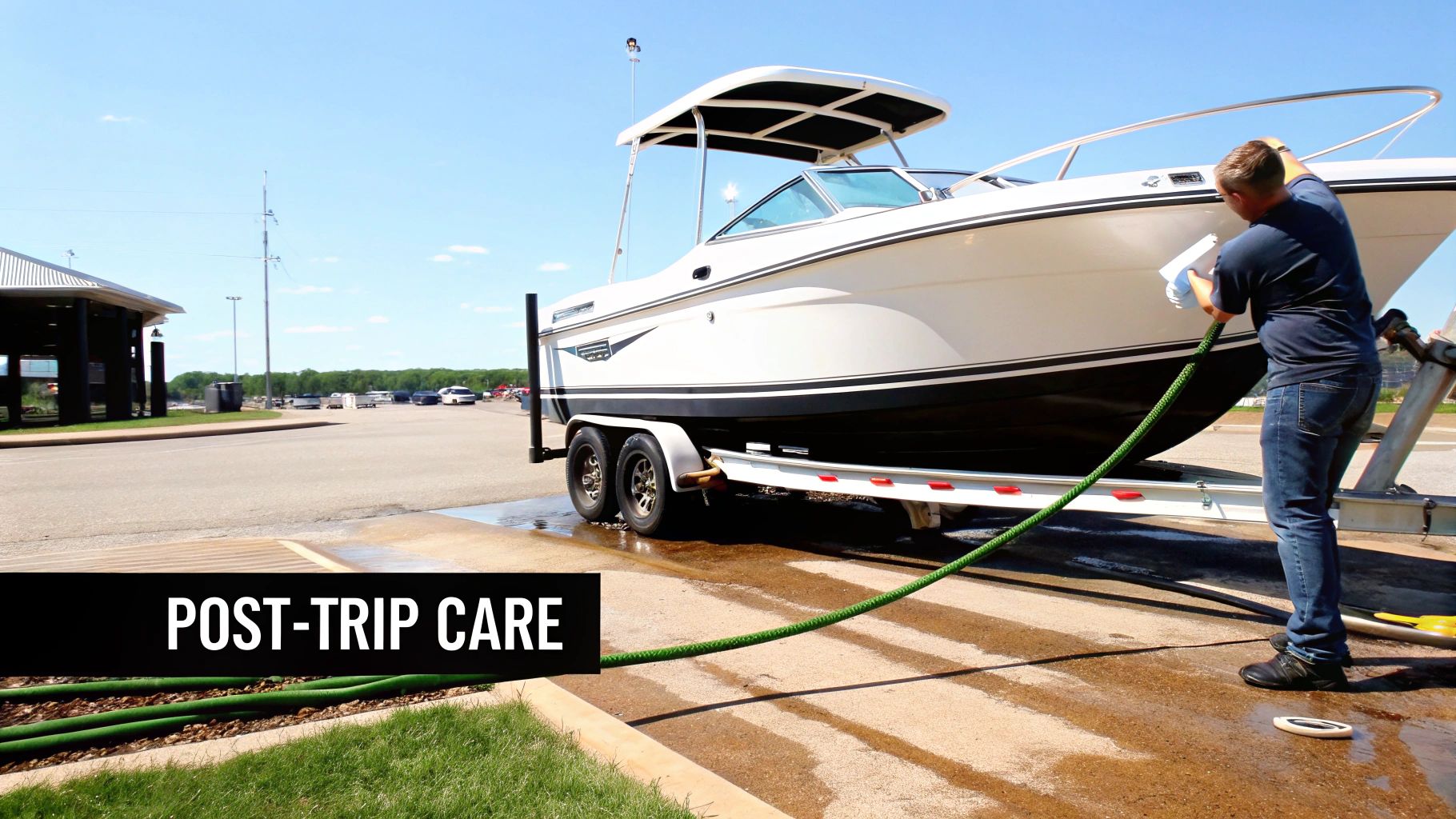
The trick is to multitask. The moment your boat is on the trailer, get that salt away engine flush started. While it's running, you can get to work on the outside of your boat. This simple change will slash your cleanup time.
A Smarter, Faster Cleanup Method
Don't just stand around waiting for the engine flush to finish. With the motor running and Salt-Away working its magic, grab your other cleaning supplies. This is the perfect window to wipe down the entire boat, from the hull to the helm.
This all-in-one approach means every part of your boat gets the care it needs without you feeling like you're starting a new project every 15 minutes. It’s all about working smarter, not harder.
After a long day on the water, you just want to get the boat clean and head home. Combining the engine flush with your exterior wipe-down is the most effective way to protect your investment and get back to your evening.
By the time you’ve wiped everything down, your engine flush will be done. This seamless process stops salt from drying on your gelcoat and prevents corrosion inside your engine before it can start.
Your Complete Boat Care Kit
Want to build out your own streamlined cleaning kit? Here are a few essentials from Boat Juice that fit perfectly into this workflow:
- A High-Quality Exterior Cleaner: Boat Juice Exterior is perfect for quickly removing water spots and salt spray from the hull and topsides while your engine is flushing. Its spray-on, wipe-off formula is fast and effective.
- An Effective Interior Cleaner: Once the outside is done, Boat Juice Interior cleans and protects your vinyl seats, consoles, and non-skid surfaces from sunscreen, grime, and UV damage.
- Glass Cleaner: Don't forget your glass! A streak-free cleaner ensures you have a clear view on your next trip.
Making this efficient, multi-tasking cleanup your post-trip habit does more than just clean your boat—it preserves its value and makes sure it's always ready for your next adventure. For more ideas on building the perfect cleaning arsenal, check out our guide to the best boat cleaning products.
Got Questions About Salt Away? We've Got Answers.
Even with a straightforward task like this, it's normal to have questions. When it comes to your engine, you want to be sure you're doing it right.
Here are answers to the most common questions we get from boaters about using Salt Away. Let's clear up any confusion and get you flushing with confidence.
How Often Do I Really Need to Flush My Engine?
This is the number one question we hear. The answer is simple: flush your engine after every single trip in saltwater. Every. Single. Time.
It doesn't matter if you were out for 30 minutes or all day long. Salt gets in, and letting it sit is what causes damage. Make it part of your end-of-day routine, just like hosing down the deck. For freshwater boaters, flushing every few trips is still a great habit for clearing out muck, sand, or algae.
Is Salt Away Safe for My Older Engine?
Absolutely. In fact, it's one of the best things you can do for an older motor. Salt Away is safe for engines of any age, from a brand-new outboard to that trusty old two-stroke that's been in the family for years.
The formula is non-toxic and biodegradable, so it’s gentle on gaskets, seals, and your rubber impeller. Its only job is to dissolve salt crystals and prevent rust, not harm your engine's internal parts.
A common worry is that a flushing solution might be "too harsh" for an older motor. The reality is that the existing salt buildup is the real enemy. Salt buildup is what chokes off water flow and causes overheating. A good flush can help restore lost cooling efficiency.
Uh Oh, I Forgot to Flush Right After My Trip. Now What?
Don't worry, it happens to everyone. You get back to the dock late, you're tired, and you just want to get home. We've all been there.
While flushing right away when the engine is warm is ideal, a late flush is infinitely better than no flush at all. Just get it done as soon as you can. Running Salt Away through the system will still break down any salt that has settled in, nipping potential corrosion in the bud. Consistency over the long haul is what truly matters.
Your next step is to make this flush part of your routine. A solid engine flush is your first line of defense, but don't stop there. To keep your whole boat looking as good as your engine runs, check out the complete lineup of cleaning and detailing products from Boat Juice. You can find everything you need to protect your hull, vinyl, and glass at the official Boat Juice shop.